Saturday, 24 August 2013

Love and Responsibility Sydney Week 1: Getting the Foundation Right - Real Friendship

Plug for L&R!

Did you know that in 2012 the most popular "How to?" search in Google in Australia was "How to love?" People are confused. In an age where the more we attempt to feel technologically "connected", the more isolated we become, and the more we seek to find intimacy and fulfilment in sex, the more disillusioned and heartbroken we become. The only solution for widespread social change is to radically rethink our conceptions of how to go about fostering authentic relationships of all kinds. Karol Wojtyla's books Love and Responsibility provides us with one way of doing that, and L&R is a series of discussion groups on each of the chapters of this book.

Week 1 has been and gone already, and it focused essentially on the fundamentally important principle that every human being has a unique dignity, and is an end in themselves. They should be treated as such, and therefore there is no situation in which it is ok to use another person for our own ends. It also became evident a while that people were conflating intimacy with non-use, and so a good way to think about how we go about all our daily interactions with people is that we should see every interaction as an opportunity to love. Some people we may only get one opportunity to love them, with others we will have many. If we strive to seize each of these opportunities, our relationships can only flourish. (All this will probably make more sense when you've done the reading, below.)


Taking place in the heart of SYD every Tuesday in the UNDA Courtyard, these weekly social discussion forums for young adults will inspire you to grow in your understanding of love and flourish in your relationships. 

Reading for Tuesday 20th August 

What could a young Polish priest professor really teach anyone about love, sexuality, and relationships between men and women?

That's the question Fr. Karol Wojtyla (hereafter referred to as Karol), addressed in the introduction to his book, Love and Responsibility (L&R). Published in 1960, this book was the fruit of his extensive pastoral work with young people and his reflections on this topic while teaching in Krakow — long before the world would come to know him as Pope John Paul II.

In Love and Responsibility, Karol argues that while he may lack direct experience in marriage and sexuality, he has something that gives him an even wider perspective on these matters: a broad “second-hand experience.” As an advisor who worked closely with many young adults and married couples amidst their struggles in love and sexuality, Karol was able to draw from the experiences of a wide range of personalities, relationships, and marriages in a way that the average person could not. L&R is the fruit of this rich pastoral experience as well as his own reflections on love, sex, and marriage.

Let’s begin!

The Personalist Principle

Karol’s first major task in L&R is to lay out what he calls the “personalist principle.” According to this foundational principle for relationships, “a person must not be merely the means to an end for another person”. In other words, we should never treat the people in our lives as mere instruments to achieving our own purposes.

He explains why this is so. We are capable of self-determination. Unlike animals that act according to their instincts and appetites, persons can act deliberately. Through self-reflection, persons can choose a course of action for themselves and assert their “inner self” to the outside world through their choices. To treat a human person merely as an instrument for my own purposes is to violate the dignity of the person as a self-determining being. “[E]very person is by nature capable of determining his or her aims. Anyone who treats a person as the means to an end does violence to the very essence of the other”.

Loving or Using?

What makes it difficult to live out this basic principle for human relationships is the spirit of utilitarianism that pervades our society. In this view, the best human actions are those that are most useful. And what is useful is what maximizes my pleasure and comfort and minimizes my pain. The underlying assumption is that happiness consists in pleasure. Therefore, I should always pursue whatever brings me comfort, advantage, and benefit, and avoid whatever may cause me suffering, disadvantage, and loss.

This utilitarian view affects the way we relate to one another. If my main goal in life is to pursue my own pleasure, then I weigh my choices in life in light of how much they lead me to this goal. Hence, many people today may evaluate a relationship in terms of how useful a person is for me to achieve my goals or how much “fun” I have with this person. Karol says that once these utilitarian attitudes are adopted, we begin to reduce the people in our lives to objects to use for our own pleasure.

This helps explain why many friendships and “dating” relationships (and even marriages) today are so fragile and so easily dissolved. If I value a woman only insofar as she is advantageous for me to know or only to the extent that I derive some pleasure from being with her, then there is not much of a foundation for the relationship. As soon as I cease to experience pleasure or benefit from my time with her — or as soon as I can find more pleasure or benefit with someone else — she no longer is valuable to me. This view is quite far from the personalist principle and even farther from a relationship of committed love.

Love and Friendship

Here, it may be helpful to mention the different kinds of friendship according to Aristotle.

For Aristotle, there are three kinds of friendship based on three kinds of affection that unite people. First, in a friendship of utility, the affection is based on the benefit or use the friends derive from the relationship. Each person gets something out of the friendship that is to his advantage, and the mutual benefit of the relationship is what unites the two people.

For example, many work-related friendships fall under this category. Let's say Bob owns a construction company in Newcastle. He has a friendship with Sam on the Central Coast because Sam sells the kind of nails that Bob needs at the best price. For their business exchanges, Bob and Sam see each other a few times a year, talk on the phone about once a week, and email each other regularly. Over the years of doing business together, they have learned about each other's careers, families, and interests. They get along together well and sincerely wish each other all the best in life. They are friends, but what unites them is the particular benefit they each receive from the friendship: nails for Bob and sales for Sam.

Second, in a pleasant friendship the basis of affection is the pleasure one gets out of the relationship. One sees the friend as a cause of some pleasure for himself. This friendship is primarily about “having fun together.” The friends may listen to the same music, play the same sport, enjoy the same form of exercise, live in the same dormitory, or like to hang out at the same nightclub. The two people may sincerely care about each other and wish each other well in life, but what unites them as friends is primarily the pleasure or “good times” they experience together.

Fragile Foundations

Aristotle notes that while the useful and pleasant friendships are basic forms of friendship, they do not represent friendship in the fullest sense. Useful and pleasant friendships are not necessarily bad but they are the most fragile. They are the least likely to stand the test of time because when the mutual benefits or “fun times” no longer exist, there is nothing left to unite the two people. For example, if Sam leaves the nail selling business to go sell books, what will happen to his friendship with Bob now that he no longer sells the nails Bob needs? Sam and Bob may still exchange Christmas cards and emails every once in a while, but since they no longer need to communicate regularly for their business transactions, their friendship most likely will begin to dissolve. The relationship is no longer mutually useful.

Similarly, in the pleasant friendship, when one person's interests change or they move away and are no longer around to share “good times,” the friendship is likely to fade. This helps explain why friendships among young people shift so often. As they move from high school to college to the professional world, they mature and their interests, values, moral convictions, and geographical locations tend to undergo many changes. If their friendships in these transitional years are not based on something more profound than simply the fact that they happened to live in the same dorm, play the same sport, take the same class, and have a lot of fun together, their friendships are likely to dissolve over time.

Such friendships based on having “good times” together are unlikely to continue when those pleasurable experiences are no longer able to be shared.

Virtuous Friendship

For Aristotle, the third form of friendship is friendship in the fullest sense. It can be called virtuous friendship because the two friends are united not in self-interest, but in the pursuit of a common goal: “the good life,” the moral life that is found in virtue.

The problem with useful and pleasant friendships is that the emphasis is on what I get out of the relationship. However, in the virtuous friendship, the two friends are committed to pursuing something outside themselves, something that goes beyond their self-interests. And it is this higher good that unites them in friendship. Striving side-by-side toward the good life and encouraging one another in the virtues, the true friend is primarily concerned not with what he gets out of the friendship, but with what is best for his friend and with pursuing the virtuous life with his friend.

What Makes or Breaks a Relationship

With this background in mind, Karol gives us the key that will prevent our relationships from falling into the self-centred waters of utilitarianism. He says the only way two human persons can avoid using each other is to relate in pursuit of a common good, as in the virtuous friendship. If the other person sees what is good for me and adopts it as a good for himself, “a special bond is established between me and this other person: the bond of a common good and of a common aim”. This common aim unites people internally. When we don't live our relationships with this common good in mind, we inevitably will treat the other person as a means to an end, for some pleasure or use.

Especially in marriage, there is a temptation to be self-centred, to want our spouse and our children to conform to our own plans, schedules, and desires. For example, when the weekend approaches, I may focus on the things I want to do — house projects I want to get done, work I want to get caught up on, sporting events I want to watch — without giving priority to what my wife and children may need from me. When it comes to family finances, I may joyfully agree to spend money on things that are important to me, but strongly resist my wife's desire to invest in something that may not benefit me directly, even though it may be important for our family.

However, Karol reminds us that true friendship, especially friendship in marriage, must be centred on the bond of a common aim. In marriage, that common aim involves the union of the spouses, the spouses' serving each other and helping each other grow in goodness, and the rearing and education of children.

Our own individual preferences and agendas should be subordinated to these higher goods. Husband and wife must be subordinate to each other and to the good of their children, working to prevent any selfish individualism from creeping into their marriage. As a team, husband and wife work toward this common aim and discern together how best to use their time, energy, and resources to achieve those common goals of marriage.

Karol explains how spouses’ being united in this common good helps ensure that one person is not being used by another or neglected by the other. “When two different people consciously choose a common aim this puts them on a footing of equality and precludes the possibility that one of them might be subordinated to the other. Both . . . are as it were . . . subordinated to that good which constitutes their common end”.

Without this common end, our relationships inevitably will fall into some form of using the person for our own benefit or pleasure.

In the next week, we will consider how crucial these foundational points from L&R are for navigating the emotional and physical attractions we often experience when we encounter people of the opposite sex.

Thursday, 22 August 2013

Cardinal Pell on Religious Liberty

Last night His Eminence George Cardinal Pell delivered the Annual Lecture on Religious Liberty at the University of Notre Dame. He was a pleasure to listen to, as always.

Some excerpts:
Todd Johnson, an expert on Christian demography with the World Christian Database, has estimated that there were 100,000 new Christian martyrs each year between 2000 and 2010, many from the Sudan and Congo. Citing Johnson's research, Italian sociologistMassimo Introvigne has claimed that a Christian is killed every five minutes.

 A special commission established as part of the Church's preparations for the Great Jubilee of 2000 arrived at a lower estimate than Johnson. It concluded that were perhaps twenty-seven million Christian martyrs in the twentieth century, making up "two thirds of the entire martyrology of the first two millennia". However the estimates might be drawn up, it seems clear that more Christians were killed for their faith in the twentieth century "than in the previous nineteen centuries combined."

Recently at Sydney University, a pro-life group founded Life Choice, a society to promote discussion around abortion and euthanasia. For such a group to be affiliated with the Student Union and receive some funding, they are required to hold an initial meeting with at least twenty members and then make application. Their first application was denied by a subcommittee because such a group would not enhance student life! An appeal against this exclusion was made to the full Student Union board and the Life Choice group won affiliation by one vote.
Two details are interesting. Professor Peter Singer, the Australian philosopher from Princeton University, intervened to support the right of Life Choice to affiliate; and one of the Student Union opponents proclaimed that a woman's right to choose abortion comes before freedom of expression. Here we have a glimpse of the future.

Protections, not exemptions. Federal and state anti-discrimination laws usually include a range of "exemptions" or "exceptions" for religious organisations (and other groups). The purpose of these exemptions is to protect other rights, but the language of exemptions creates the impression that they are simply concessions or special permissions to discriminate granted by the state for political reasons. This is completely misleading and helpful to no one, except those who want to misrepresent the situation and remove protections for religious freedom. The language of exemptions should be replaced with the language of protections, clearly identifying the human right that is being protected.

Go read the whole thing!

+AMDG

Wednesday, 14 August 2013

Rearranging the Rosary: The Fifth Mysteries (Consummation)

Previously:
Rearranging the Rosary: An Introduction
The First Mysteries (In the Beginning)
The Second Mysteries (Discipleship)
The Third Mysteries (Kingdom of God)
The Fourth Mysteries (Pilgrimage)

Today is my favourite. I wish I had time to write a whole essay on this, but I'll have to settle for brevity.

The Fifth Joyful Mystery: The Finding of the Child Jesus in the Temple
Finding of the Child Jesus
in the Temple

The Fifth Luminous Mystery: The Institution of the Blessed Eucharist
  • In the Eucharist we meet the Risen Christ, and thus experience a foretaste of Heaven, the fulfilment of all our desires, in which Christ and His Bride become one flesh, the Body of Christ. But also it is mysteriously one and the same sacrifice of Calvary, which Christ is offering before the Father for all eternity.

The Fifth Sorrowful Mystery: The Crucifixion and Death of Our Lord
  • Before He gave up His spirit, Christ said "it is finished", probably better translated as "it is consummated." (Jn. 19:30) Scott Hahn has a great discussion of this, where he argues that the "it" that is completed is the Passover sacrifice, begun at the Last Supper (which is the Institution of the Eucharist).

The Fifth Glorious Mystery: The Coronation of Our Lady Queen of Heaven
  • Since today is the feast of the Assumption, the readings for today were very much linked to this. The Mother of God takes her place in Heaven (Rev. 12:1), reflected also in Psalm 45. In this, as she begins her eternal life with her Divine Father, Son and Spouse, as a fully redeemed human person, she shows us the glory to which we are called. We see this in Christ, but He is not a human person, He is a Divine Person, and had no need of salvation. Mary is the first one for whom salvation is fully realised, and thus in this Mystery we see the climax of what all the other Mysteries have been building up to. The salvation of humanity is possible, because it has been accomplished in one person already.

So what's the point?

We begin our lives as disciples of Christ, becoming a part of and working towards the complete fulfilment of the Kingdom of God whilst on our pilgrimage to Heaven, which will be the consummation of our marriage with God, so to speak; the realisation of the end for which we were created, which is to live in a communion of love with the Trinity for all eternity.

Next time: Wrapping it up

+AMDG

Tuesday, 13 August 2013

Rearranging the Rosary: The Fourth Mysteries (Pilgrimage)

Previously:
Rearranging the Rosary: An Introduction
The First Mysteries (In the Beginning)
The Second Mysteries (Discipleship)
The Third Mysteries (Kingdom of God)

So far, we have seen that as we go through each set of Mysteries in the Rosary, we see the Christian life cyclically reflected in the specific part of salvation history pertaining to Christ's life. (Of course it is also reflected this way throughout all of salvation history.)

Today we're gonna take a squiz at the Fourth Mysteries, which suggest the idea of pilgrimage.

The Fourth Joyful Mystery: The Presentation of the Child Jesus in the Temple
  • the Holy Family's journey to the Temple in Jerusalem is a pilgrimage. Further to this, when we consider that the Temple is essentially modelled on God's heavenly court, and is a microcosm of the New Eden, travelling to Jerusalem is like both the Jewish exodus to the Promised Land, and our journey to our true Promised Land, Heaven

The Fourth Luminous Mystery: The Transfiguration of Our Lord
  • In the account of the Transfiguration in Luke, we read:
"And behold, two men talked with him, Moses and Eli'jah, who appeared in glory and spoke of his departure, which he was to accomplish at Jerusalem." (Lk. 9:30-31)
The greek word used for departure here is actually exodos. Jesus is depicted as the New Moses, and so when we put all this together, in the redemption He accomplished at Jerusalem, Christ, the New Moses, instituted the New Exodus of the New People of God, the Church, as they journey to the New Promised Land (as we'll see tomorrow, there's a New Manna too! Also New Law, New Covenant, etc, you get the idea)
The Fourth Sorrowful Mystery: The Carrying of the Cross
  • Jesus instructs those who would be His disciples that they must "take up their cross daily, and follow Him."

The Fourth Glorious Mystery: The Assumption of Our Lady into Heaven
    The Assumption
  • Our Lady completes the last leg of her pilgrimage to Heaven (and this is tomorrow's feast day, incidentally! And a holy day of obligation, don't forget.)

Putting it all together: we begin our lives as disciples of Christ, becoming a part of and working towards the complete fulfilment of the Kingdom of God whilst on our pilgrimage to Heaven.

Next up: The Fifth Mysteries (Consummation)

+AMDG

Monday, 12 August 2013

The Error of Compartmentalisation

The excellent Jason has kindly included myself in a list of his friends with good blogs. Over on his blog, with the awesome Phantom-of-the-Opera-esque name (at least that's what I think of) The Masked Thomist, Jason regularly displays his talent for concisely distilling his own thoughts, or those of others, deftly rebutting where appropriate. He also courageously shares various personal struggles, which I find quite inspiring, as well as helpful, providing a perspective not much voiced in the Catholic world.


Also on this list was the very new (only one post so far!) Platitudes in the Making. This first post was on the problem of compartmentalisation, with specific reference to mathematics and music. As someone with a degree in Advanced Mathematics, naturally this caught my attention. It's a very interesting read: did you know, for example that
Beethoven loved to take geometric figures and twist them, raise or lower them, taking certain points on the figures as musical notes, and write entire motifs that way.
What a cool way to compose!!

This compartmentalisation has troubled me for some time in other areas though, especially in the area of university education. It seems to me that the widespread specialisation of most degrees is not the best of ideas. Admittedly, part of the reason why I did Maths was because I hated essays, thought I was no good at them, nor could I ever be, because I just wasn't one of those "English-y types". If I'd been forced to non-Maths or Science subjects, I'd have been pretty ticked off, back in the day.

But now I think that learning to think in a variety of different ways, and learning skills different to the ones that you excel at, is ridiculously important.

When universities began, this was well understood. One didn't simply pick a specific area to be educated in, and specialise right from the get-go. You had to study rhetoric, grammar, logic, arithmetic, music, geometry and astronomy, before you could study philosophy, and before you reached the queen of all studies, theology. They understood that you had to be well-grounded in how the world is, how reality functions as a beautiful whole, in order to not be a slovely theologian.

These days, obviously not everyone is going to be a theologian. But I think there is nevertheless great merit in encouraging students to broaden their intellectual horizons.

Some ways this is done in Sydney:

UNSW gets their students to do a number of General Education (Gen Ed) subjects, which, as I understand it, are just subjects not in your field. This is a good start, but from what I hear most people don't take these seriously, don't really understand why they're important, and try to find "bludge" subjects: in other words, how little work they can get away with.

My own Notre Dame has the Logos Program, which basically involves getting a general introduction to the basics of philosophy, theology and ethics. This is definitely awesome in theory, but I'm not sure how much students get out of it (as I think many probably resent having "Catholic stuff shoved down our throats"), and also it's only three subjects worth.

Campion College is the winner on this front, as it offers the Liberal Arts degree, and that's all it does. Basically, you sit at the feet of history's greatest thinkers, and learn to think and express yourself well, in the areas of history, literature, philosophy, science and theology. By doing so Campion hopes to produce the leaders of the next generation, who are able to think well no matter what profession they choose to enter. Here, crucially, one's specialisation is delayed slightly, which I don't think is any bad thing. Many I have talked to, however, think it's a bit of a waste of time.

This pretty much because education is not generally seen as a good in itself, but merely as a means to getting a degree in something, so you can work. The idea of educating the whole person, aiding them in their pursuit of wisdom, so that they can live a virtuous life in accordance with what we were created for, and thus find true fulfilment, is non-existent in most universities. At Sydney Uni, I pretty much felt like one nobody among many, part of a production-line of graduates, helping the uni make money. This is the sorry state of our unis, which is not going to do society any favours, because university graduates go on to get positions of power and influence, and if they're not well-formed individuals, they're not likely to make well-informed decisions. And I think this is already being seen.

So, to conclude: if you have the chance to not narrow your straight after school, putting yourself into the "teaching" box, or the "politics" box, or the "science" box, or the "IT" box, go for it. Stretch those intellectual muscles! The world needs people who can both think logically and clearly, and express that well, whether in writing or verbally, and who know something of the rich inheritance of knowledge our forebears have bequeathed to us, so that they can contribute something valuable of their own.

+AMDG
 

Sunday, 11 August 2013

Rearranging the Rosary: The Third Mysteries (Kingdom of God)

Previously:
Rearranging the Rosary: An Introduction
The First Mysteries
The Second Mysteries

Finding a clear theme for the Second Mysteries is not so easy, and perhaps you found the result a bit dubious. Today, however, is much clearer, I think.

The Third Joyful Mystery: The Birth of Our Lord

  • Christ the King is born! He is recognised as such by the three wise men, who bring Him appropriate gifts.

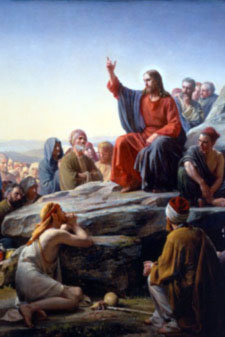
The Third Luminous Mystery: The Proclamation of the Kingdom of Heaven

    Sermon on the Mount
  • At the Sermon on the Mount, Christ proclaims that the Kingdom of Heaven is at hand (because He is here and the redemption that He is going to bring about draws near)

The Third Sorrowful Mystery: The Crowning with Thorns

  • Jesus is mocked by the soldiers for claiming to be King, by dressing Him in purple and setting a crown of thorns on His head. They taunt Him, and spit on Him. Little did they know that they were deriding He who truly is King of the Universe. (Yikes)

The Third Glorious Mystery: The Descent of the Holy Spirit on the Apostles

  • The pouring out of the Holy Spirit marked the birth of the Church, which is the Kingdom of God. What was accomplished on Calvary and in the Resurrection, was manifested anew in the Church, to be the means for the perpetuation of these salvific realities for all time. 

Thus, at some point we begin our lives as disciples of Christ, which involves both becoming a part of and working towards the complete fulfilment of the Kingdom of God.

Next up: The Fourth Mysteries

+AMDG

Saturday, 10 August 2013

Rearranging the Rosary: The Second Mysteries (Discipleship)

To make sense of this post, I suggest you check out the following:
Rearranging the Rosary: An Introduction
The First Mysteries

Today, I'll take an oh-so brief look at the Second Mysteries.

The Second Joyful Mystery: The Visitation
  • Right after learning that she is to be the Mother of God, Mary hurries over to assist her cousin Elizabeth, whom she has just learnt is also expecting, in her old age. This kind of service, that completely forgets the self, is what we are called to as disciples
  • John the Baptist, not even born yet, leaps for joy as he recognises that he is in the presence of the Lamb of God. Does being in God's presence lead to awe, amazement, and joy?
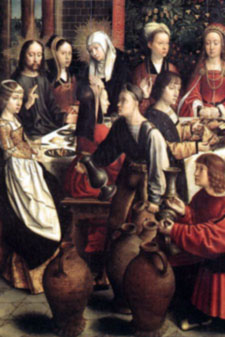
The Second Luminous Mystery: The Wedding at Cana 
The Wedding at Cana

  • Our Lady's instructions to the servants: "Do whatever He tells you," provide the model for discipleship
  • This was the first sign that Jesus performed, and John tells us that the disciples "believed in Him"; (Jn. 2:11) belief in Christ is the crux of being a disciple.
The Second Sorrowful Mystery: The Scourging of Our Lord at the Pillar
  • We can unite the sufferings that we encounter, as disciples of Christ, with the immense suffering that the One whom we follow went through for us 
The Second Glorious Mystery: The Ascension of Our Lord into Heaven
  • Our Lord's final instruction to His Apostles before He left them, was to "Go, make disciples of all nations."
So, our Christian life has some kind of beginning, and this is the beginning of being a disciple of Christ, which involves a life of service, suffering, obedience, and a joy that should overflow with such abundance that we are led to share Christ with others.  

Next up: The Third Mysteries

+AMDG