Friday, 12 July 2013

Unity between denominations? Part IV: The Witness of the Early Church in the Church Fathers

Previously:
Part I: The Problem
Part II: What kind of unity are we called to?
Part III:  The Witness of the Early Church in the New Testament

Even a cursory perusal of the Church Fathers reveals a Church that considered its visible unity to be of utmost importance. 

1. The Didache (around the turn of the 1st Century)
  • has clear references to a hierarchical structure (bishops and deacons)
  • also makes clear the importance of the sacraments for communion with the Church, as only those baptised may receive of the Eucharist
2. St Clement of Rome (4th Bishop of Rome) (Letter written 96AD)
  • Tertullian tells us he was ordained by St Peter (Ch. 32) himself
  • His Letter to the Corinthians is proto-canonical, which means it was read sometimes in the early liturgies
  • In his Letter to the Corinthians, he says
    • "Our apostles also knew, through our Lord Jesus Christ, that there would be strife on account of the office of the episcopate. For this reason, therefore, inasmuch as they had obtained a perfect fore-knowledge of this, they appointed those [ministers] already mentioned, and afterwards gave instructions, that when these should fall asleep, other approved men should succeed them in their ministry. " (Ch. 44)
    • he sees no conflict between saying that members of the Church should not exalt themselves over one another, and yet the established order ought to be maintained. (Ch. 38-42)
    • He condemns their schisms, (Ch. 46) which are even worse than they were at the time of St Paul (recall 1 Cor. 1-3 in particular, and that this is the same Church, the Church in Corinth). He goes so far as to say that through their schisms, the name of the Lord is blasphemed.
    • He speaks as though he expects them to obey, even though he is bishop of Rome and not of Corinth, indicating that already, in 96AD, the seat of Rome was accorded some kind of primacy. (Ch. 59: "If, however, any shall disobey the words spoken by Him through us, let them know that they will involve themselves in transgression and serious danger." See also Ch. 63.)
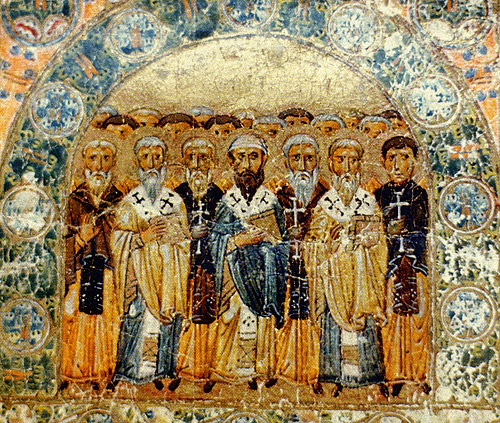
Church Fathers, a miniature from Svyatoslav's Miscellany
3. St Ignatius of Antioch: (3rd Bishop of Antioch) (around the turn of the 1st Century)
  • In his Letter to the Ephesians, he repeatedly asserts the necessity of remaining in communion with one's bishop (Chs. 4-6), even going so far as to say "Let us be careful, then, not to set ourselves in opposition to the bishop, in order that we may be subject to God...It is manifest, therefore, that we should look upon the bishop even as we would upon the Lord Himself." Big call, dude. He also condemns false teachers numerous times, citing the bishops as the bulwark against their heresies.
  • Letter to the Philadelphians: "I salute in the blood of Jesus Christ, who is our eternal and enduring joy, especially if [men] are in unity with the bishop, the presbyters, and the deacons, who have been appointed according to the mind of Jesus Christ, whom He has established in security, after His own will, and by His Holy Spirit."
  • This theme is found in all his letters (all of which you can find here, there are just too many choice quotes to include in this post, I'd end up quoting most of the content), except, interestingly, in his Letter to Rome. It is in this letter alone that he does not presume to correct the Church in their behaviour, nor in their doctrines. This fact, along with the overall tone suggests that he was writing to one whom he thought a superior of some kind.
  • On remaining separate from heretics:
    • "They abstain from the Eucharist and from prayer, because they confess not the Eucharist to be the flesh of our Saviour Jesus Christ, which suffered for our sins, and which the Father, of His goodness, raised up again. Those, therefore, who speak against this gift of God, incur death in the midst of their disputes. But it were better for them to treat it with respect, that they also might rise again. It is fitting, therefore, that you should keep aloof from such persons, and not to speak of them either in private or in public, but to give heed to the prophets, and above all, to the Gospel, in which the passion [of Christ] has been revealed to us, and the resurrection has been fullyproved. But avoid all divisions, as the beginning of evils." (Ch. 7 Letter to the Smyrneans)
      Here Ignatius ties unity of faith with the sacrament of visible unity, the Eucharist.
4. St Cyprian: (Bishop of Carthage 249-258 AD)

How St Cyprian viewed Church unity.

5. St Vincent of Lerins: (mid-5th century)

He wrote a detailed work regarding how the unity of faith is to be maintained.

I could go on and on. Here is another list, some of these I have quoted already.

Just to recap the characteristics pertaining to unity that have come out of these brief examinations of the Church in the New Testament and early centuries:
  • There is one universal Church
  • There are local churches
  • It is visible, both hierarchically and sacramentally, and these are intimately connected
Part V: Visible vs. Invisible Unity

+AMDG

Monday, 8 July 2013

The Fellowship of the Unashamed


I heard this read by apologist Patrick Madrid at a talk he gave in Sydney some time ago. I printed it out and keep it on my wall, as I think it's rather good. Enjoy. [Hopefully tomorrow I'll have written something of my own again, at last.]


I AM A PART of the Fellowship of the Unashamed.

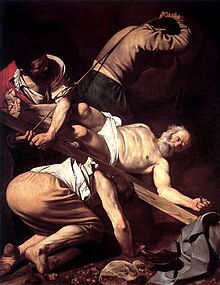
St Peter remaining faithful to Christ unto death

The die has been cast. The decision has been made. I have stepped over the line. I won't look back, let up, slow down, back away or be still.

My past is redeemed, my present makes sense, and my future is in God's hands. I am finished and done with low living, sight walking, small planning, the bare minimum, smooth knees, colorless dreams, tamed visions, mundane talking, frivolous living, selfish giving, and dwarfed goals.

I no longer need preeminence, prosperity, position, promotions, applause, or popularity. I don't have to be right, first, the best, recognized, praised, regarded, or rewarded. I now live by faith. I lean on Christ's presence. I love with patience, live by prayer, and labor with the power of God's grace.

My face is set. My gait is fast, my goal is heaven. My road is narrow, my way is rough, my companions are few, my Guide is reliable, and my mission is clear.

I cannot be bought, compromised, detoured, lured away, turned back, deluded, or delayed. I will not flinch in the face of sacrifice, hesitate in the presence of adversity, negotiate at the table of the enemy, ponder at the pool of popularity, or meander in the maze of mediocrity.

I won't give up, shut up, let up or slow up until I have stayed up, stored up, prayed up, paid up, and spoken up for the cause of Christ.

I am a disciple of Jesus. I must go till He comes, give until I drop, speak out until all know, and work until He stops me.
And when He returns for His own, He will have no difficulty recognizing me. My banner is clear: I am a part of the Fellowship of the Unashamed.

Sunday, 7 July 2013

Footprints Poem... with a twist!


A hilarious poem introduced to me by Fr Emmerich Vogt in his talk yesterday! Enjoy. :)


Butt Prints In The Sand

One night I had a wondrous dream,
One set of footprints there was seen,
The footprints of my precious Lord,
But mine were not along the shore.

But then some stranger prints appeared,
And I asked the Lord, "What have we here?"
Those prints are large and round and neat,
"But Lord they are too big for feet."

"My child," He said in somber tones,
"For miles I carried you alone.
I challenged you to walk in faith,
But you refused and made me wait."

"You disobeyed, you would not grow,
The walk of faith, you would not know.
So I got tired, I got fed up,
and there I dropped you on your butt."

"Because in life, there comes a time,
when one must fight, and one must climb.
When one must rise and take a stand,
or leave their butt prints in the sand."

Friday, 5 July 2013

Wednesday, 3 July 2013

Sacred Tradition is like a Compression Wave: ND Tradition Conference Day 1

In all seriousness.

So today was Day 1 of Notre Dame's Tradition Conference. My summary will be based around this little analogy. By Sacred Tradition I refer to the whole deposit of faith, both written (Scripture) and oral (which has since been found in writing as well as those after the Apostles attempt to grapple with what was handed on orally) tradition.

"Secret" Niccoline Chapel discussed by Bishop Anthony Fisher
in relation  to Catholic Moral Tradition


Compression Waves:

These are the types of waves involved in sound, or slinkies. They look like this:


Characteristics:

  • The flow of energy is one-directional 
To see what I mean, look at this animation (the first one, longitudinal waves are another name for compression waves).
  • The particles oscillate in a direction parallel to the direction of the flow of energy (again, see animation above).  In other words, the particles interact on the same plane.

What does this have to do with Sacred Tradition?

I think many of the things said today can be tied into this model. I'll look at each characteristic separately. For the purposes of the analogy, each particle may be thought of as an individual person, who participates in the complex overall chain-web of "handing on" the deposit of faith.

  • "Traditioning" is the process of handing on the deposit of faith. As such, it necessarily moves in one direction chronologically, as each generation preserves the faith by handing it on to the next. Hence the parallel with the notion of a wave, which by definition is a transmission of energy in one direction, while here we have transmission of truths in one direction.
  • The oscillations of individual particles are representative of the ongoing dialectic that takes place in the process of traditioning. 
    • If we zoom out, taking a long view of history, we see only the overall movement in one direction. But if we zoom right into individual lives, we see that there is a back-and-forth going on. One doesn't simply receive the whole deposit in one go, and then proceed to hand it on. Indeed, one person never receives the whole, they simply absorb a limited amount over their lifetime, all the while constantly transmitting what they have already internalised to others. 
    • There is a perpetual vacillation between actively receiving the faith from someone you trust, and then passing on what you have received, to a new recipient. This active reception involves choosing to believe and accept tradition as a reliable source of truth, which is possible only because we have the Holy Spirit working as the guarantor that the Church will maintain fidelity to His original inspiration of the Apostles. It must involve the application of one's intellect to what is received, interpreting and understanding it, finally internalising it as one comes to grips with how best to express these truths to the next generation, which will always be slightly different from one's own. There is an engagement between the transmitter and the receiver as the transmitter strives to pass on what he is passionate about, in such a way that the receiver will not only receive the content but the same love for this content as well, and thus inherit the urge to pass it on again, while simultaneously, the receiver interrogates and evaluates what is being presented. This dynamic interaction is the essence of what keeps Tradition living, as it respects the past, confronts the immediate present, and has a concern for the future. Such interaction can only really occur in relationships of mutual concern and respect, namely in the family, "the domestic Church", and friendships. The fact that such relationships are where the action happens in terms of bringing humanity to Christ has been amply borne out in history.
    • The truths of Sacred Tradition are made concrete in actions, in the living out of that faith. Actions are the fruit of the authentic reception of the truth. These are manifested in the traditions of the Church (distinguishing here between Tradition and traditions), each of which express, or ought to express, truths of the unchanging Tradition, for particular times. Thus, many of these will undergo transformations over the centuries, as different generations seek to express the Tradition in action intelligibly for the Church and the world.
    • It is impossible to not have traditions as human beings, and so it is important to be aware of this so that we may be discerning about which traditions we choose to adhere to.
    • If people have a duty to try to seduce or persuade people to cherish what they cherish (for if they see it as worth cherishing then surely they would want to share that at least with the people they care about), then in particular each Christian, if they are passionate about Christ, then has a responsibility to strive to "hand on" this encounter with the Lord.
In short, the one directional movement of energy in a compression wave is like the one directional movement of the deposit of faith in Sacred Tradition, while the oscillations of the individual particles are like the ongoing reception-transmission that take place on the individual level.

If you think you're missing out by not attending this conference, you're right. Sorry. ;)

+AMDG

Monday, 1 July 2013

The Paradox of Our Age

“The Paradox of Our Age”, from Words Aptly Spoken, by Bob Moorehead


We have taller buildings but shorter tempers; wider freeways but narrower viewpoints; we spend more but have less; we buy more but enjoy it less; we have bigger houses and smaller families; more conveniences, yet less time; we have more degrees but less sense; more knowledge but less judgement; more experts, yet more problems; we have more gadgets but less satisfaction; more medicine, yet less wellness; we take more vitamins but see fewer results. 
We drink too much; smoke too much; spend too recklessly; laugh too little; drive too fast; get too angry quickly; stay up too late; get up too tired; read too seldom; watch TV too much and pray too seldom.

We have multiplied our possessions, but reduced our values; we fly in faster planes to arrive there quicker, to do less and return sooner;
we sign more contracts only to realize fewer profits;
 we talk too much; love too seldom and lie too often.
We’ve learned how to make a living, but not a life; we’ve added years to life, not life to years.
We’ve been all the way to the moon and back, but have trouble crossing the street to meet the new neighbor. 
We’ve conquered outer space, but not inner space;
we’ve done larger things, but not better things;
we’ve cleaned up the air, but polluted the soul;
we’ve split the atom, but not our prejudice;
 we write more, but learn less;
plan more, but accomplish less;
we make faster planes, but longer lines;
we learned to rush, but not to wait;
we have more weapons, but less peace;
higher incomes, but lower morals;
more parties, but less fun;
more food, but less appeasement;
more acquaintances, but fewer friends;
more effort, but less success.
We build more computers to hold more information, to produce more copies than ever, but have less communication;
drive smaller cars that have bigger problems;
build larger factories that produce less.
We’ve become long on quantity, but short on quality.

These are the times of fast foods and slow digestion;
tall men, but short character;
steep in profits, but shallow relationships.
These are times of world peace, but domestic warfare;
more leisure and less fun;
higher postage, but slower mail;
more kinds of food, but less nutrition.
These are days of two incomes, but more divorces;
these are times of fancier houses, but broken homes.
These are days of quick trips, disposable diapers, cartridge living, thow-away morality, one-night stands, overweight bodies and pills that do everything from cheer, to prevent, quiet or kill.
It is a time when there is much in the show window and nothing in the stock room.
Indeed, these are the times!
+AMDG