Showing posts with label unity. Show all posts

Sunday, 4 August 2013

Unity between denominations? Part VIII: Toward Unity

Part VII: Wounds to Unity

Having pondered the question of unity for some time now, regarding what it is, and what it is not, we finally come to consider how unity may be worked towards, by the individual, the local Church, and the Universal Church.

Toward unity

820 "Christ bestowed unity on his Church from the beginning. This unity, we believe, subsists in the Catholic Church as something she can never lose, and we hope that it will continue to increase until the end of time."277 Christ always gives his Church the gift of unity, but the Church must always pray and work to maintain, reinforce, and perfect the unity that Christ wills for her. This is why Jesus himself prayed at the hour of his Passion, and does not cease praying to his Father, for the unity of his disciples: "That they may all be one. As you, Father, are in me and I am in you, may they also be one in us, . . . so that the world may know that you have sent me."278 The desire to recover the unity of all Christians is a gift of Christ and a call of the Holy Spirit.279

821 Certain things are required in order to respond adequately to this call:
- a permanent renewal of the Church in greater fidelity to her vocation; such renewal is the driving-force of the movement toward unity;280
- conversion of heart as the faithful "try to live holier lives according to the Gospel";281 for it is the unfaithfulness of the members to Christ's gift which causes divisions;
- prayer in common, because "change of heart and holiness of life, along with public and private prayer for the unity of Christians, should be regarded as the soul of the whole ecumenical movement, and merits the name 'spiritual ecumenism;"'282
- fraternal knowledge of each other;283
- ecumenical formation of the faithful and especially of priests;284
- dialogue among theologians and meetings among Christians of the different churches and communities;285
- collaboration among Christians in various areas of service to mankind.286 "Human service" is the idiomatic phrase.

822 Concern for achieving unity "involves the whole Church, faithful and clergy alike."287 But we must realize "that this holy objective - the reconciliation of all Christians in the unity of the one and only Church of Christ - transcends human powers and gifts." That is why we place all our hope "in the prayer of Christ for the Church, in the love of the Father for us, and in the power of the Holy Spirit."288


Part IX: What can I do?

Monday, 22 July 2013

Unity between Denominations? Part VI: The unity of the Church in Her own words

Previously:

Part I: The Problem
Part II: What kind of unity are we called to?
Part III:  The Witness of the Early Church in the New Testament
Part IV: The Witness of the Early Church in the Church Fathers
Part V: Visible vs. Invisible Unity

The next few parts will mostly be sections from our beloved Catechism.

First up: How is the Church Christ founded One?


813 The Church is one because of her source: "the highest exemplar and source of this mystery is the unity, in the Trinity of Persons, of one God, the Father and the Son in the Holy Spirit."

The Church is one because of her founder: for "the Word made flesh, the prince of peace, reconciled all men to God by the cross, . . . restoring the unity of all in one people and one body."

The Church is one because of her "soul": "It is the Holy Spirit, dwelling in those who believe and pervading and ruling over the entire Church, who brings about that wonderful communion of the faithful and joins them together so intimately in Christ that he is the principle of the Church's unity."

Unity is of the essence of the Church: What an astonishing mystery! There is one Father of the universe, one Logos of the universe, and also one Holy Spirit, everywhere one and the same; there is also one virgin become mother, and I should like to call her "Church."

814 From the beginning, this one Church has been marked by a great diversity which comes from both the variety of God's gifts and the diversity of those who receive them. Within the unity of the People of God, a multiplicity of peoples and cultures is gathered together. Among the Church's members, there are different gifts, offices, conditions, and ways of life. "Holding a rightful place in the communion of the Church there are also particular Churches that retain their own traditions."

The great richness of such diversity is not opposed to the Church's unity. Yet sin and the burden of its consequences constantly threaten the gift of unity. And so the Apostle has to exhort Christians to "maintain the unity of the Spirit in the bond of peace."

815 What are these bonds of unity? Above all, charity "binds everything together in perfect harmony." But the unity of the pilgrim Church is also assured by visible bonds of communion:

  • profession of one faith received from the Apostles;
  • common celebration of divine worship, especially of the sacraments;
  • apostolic succession through the sacrament of Holy Orders, maintaining the fraternal concord of God's family.

816 "The sole Church of Christ [is that] which our Savior, after his Resurrection, entrusted to Peter's pastoral care, commissioning him and the other apostles to extend and rule it. . . . This Church, constituted and organized as a society in the present world, subsists in (subsistit in) the Catholic Church, which is governed by the successor of Peter and by the bishops in communion with him."

The Second Vatican Council's Decree on Ecumenism explains: "For it is through Christ's Catholic Church alone, which is the universal help toward salvation, that the fullness of the means of salvation can be obtained. It was to the apostolic college alone, of which Peter is the head, that we believe that our Lord entrusted all the blessings of the New Covenant, in order to establish on earth the one Body of Christ into which all those should be fully incorporated who belong in any way to the People of God."

Delivery of the Keys (Perugino)

Part VII: Wounds to Unity

Sunday, 21 July 2013

Unity between Denominations? Part V: Visible vs. Invisible Unity

Previously:

Part I: The Problem
Part II: What kind of unity are we called to?
Part III:  The Witness of the Early Church in the New Testament

I have mentioned "visible" and "invisible" unity before, but without clearly defining what I mean by them and what their relationship is. Today I will attempt to rectify this.

What seems to be emerging from this series of posts is that Protestants are only able to have invisible unity, and it seems to me that they think visible unity is unimportant. Or at least, because visible unity is impossible in their paradigm, they are forced to this conclusion, otherwise they would be in the uncomfortable position of having to examine whether the whole paradigm is the problem.


The above title is actually a misnomer. There is no conflict between visible and invisible unity, in fact, they are two sides of the same reality, namely that the Church is One.

Let us consider the Church as the Body of Christ. What is a body? Well, a body without a soul is a just a corpse, and the Church is certainly not that, She is well and truly alive. She is Christ's resurrected body. In fact, She is the Incarnation continued in space and time. Thus St Joan of Arc could say, "About Jesus Christ and the Church, I simply know they're just one thing, and we shouldn't complicate the matter.” 

Thus, Church has a soul as well, in the Person of the Holy Spirit.


Hence the Church is a comprehensive unity of body and soul, of visible and invisible. If the invisible were not there, the visible would disintegrate. In other words, without the Holy Spirit acting in and through the Church, all that She said and did would lose its power and meaning. And if the visible were not there, as the manifestation of the invisible, the invisible unity would  be unrecognisable to the world, which would defeat the point of being one, which according to Christ is that people may know that we follow Christ by our oneness. And this oneness ought to be the same kind of oneness that exists between the Father and the Son.


And again, because it is precisely through the visible words and actions, and persons of the Church, that the Holy Spirit works to bring about this invisible communion, without the visible the invisible could not be sustained. They are inextricably intertwined.


There are many parallel paradoxes:
  • Scripture has both truly human and truly divine authors
  • Scripture is both a visible, limited thing and yet reveals to us the invisible, infinite God
  • Christ is both fully God and fully Man
  • The Church is both human and divine (fitting since She is intimately bound up with Her Spouse and Head)
  • a sacrament is a tangible sign of an invisible reality
These are all incarnational and sacramental, in keeping with the Catholic view of the tangible universe we live in being a "theatre of grace," the mysterious way in which the Creator interacts with His creation.


Friday, 12 July 2013

Unity between denominations? Part IV: The Witness of the Early Church in the Church Fathers

Previously:
Part I: The Problem
Part II: What kind of unity are we called to?
Part III:  The Witness of the Early Church in the New Testament

Even a cursory perusal of the Church Fathers reveals a Church that considered its visible unity to be of utmost importance. 

1. The Didache (around the turn of the 1st Century)
  • has clear references to a hierarchical structure (bishops and deacons)
  • also makes clear the importance of the sacraments for communion with the Church, as only those baptised may receive of the Eucharist
2. St Clement of Rome (4th Bishop of Rome) (Letter written 96AD)
  • Tertullian tells us he was ordained by St Peter (Ch. 32) himself
  • His Letter to the Corinthians is proto-canonical, which means it was read sometimes in the early liturgies
  • In his Letter to the Corinthians, he says
    • "Our apostles also knew, through our Lord Jesus Christ, that there would be strife on account of the office of the episcopate. For this reason, therefore, inasmuch as they had obtained a perfect fore-knowledge of this, they appointed those [ministers] already mentioned, and afterwards gave instructions, that when these should fall asleep, other approved men should succeed them in their ministry. " (Ch. 44)
    • he sees no conflict between saying that members of the Church should not exalt themselves over one another, and yet the established order ought to be maintained. (Ch. 38-42)
    • He condemns their schisms, (Ch. 46) which are even worse than they were at the time of St Paul (recall 1 Cor. 1-3 in particular, and that this is the same Church, the Church in Corinth). He goes so far as to say that through their schisms, the name of the Lord is blasphemed.
    • He speaks as though he expects them to obey, even though he is bishop of Rome and not of Corinth, indicating that already, in 96AD, the seat of Rome was accorded some kind of primacy. (Ch. 59: "If, however, any shall disobey the words spoken by Him through us, let them know that they will involve themselves in transgression and serious danger." See also Ch. 63.)
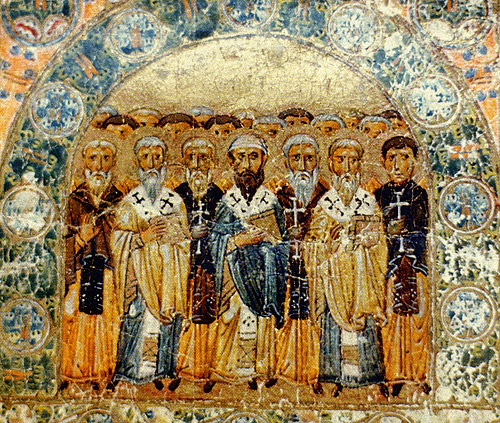
Church Fathers, a miniature from Svyatoslav's Miscellany
3. St Ignatius of Antioch: (3rd Bishop of Antioch) (around the turn of the 1st Century)
  • In his Letter to the Ephesians, he repeatedly asserts the necessity of remaining in communion with one's bishop (Chs. 4-6), even going so far as to say "Let us be careful, then, not to set ourselves in opposition to the bishop, in order that we may be subject to God...It is manifest, therefore, that we should look upon the bishop even as we would upon the Lord Himself." Big call, dude. He also condemns false teachers numerous times, citing the bishops as the bulwark against their heresies.
  • Letter to the Philadelphians: "I salute in the blood of Jesus Christ, who is our eternal and enduring joy, especially if [men] are in unity with the bishop, the presbyters, and the deacons, who have been appointed according to the mind of Jesus Christ, whom He has established in security, after His own will, and by His Holy Spirit."
  • This theme is found in all his letters (all of which you can find here, there are just too many choice quotes to include in this post, I'd end up quoting most of the content), except, interestingly, in his Letter to Rome. It is in this letter alone that he does not presume to correct the Church in their behaviour, nor in their doctrines. This fact, along with the overall tone suggests that he was writing to one whom he thought a superior of some kind.
  • On remaining separate from heretics:
    • "They abstain from the Eucharist and from prayer, because they confess not the Eucharist to be the flesh of our Saviour Jesus Christ, which suffered for our sins, and which the Father, of His goodness, raised up again. Those, therefore, who speak against this gift of God, incur death in the midst of their disputes. But it were better for them to treat it with respect, that they also might rise again. It is fitting, therefore, that you should keep aloof from such persons, and not to speak of them either in private or in public, but to give heed to the prophets, and above all, to the Gospel, in which the passion [of Christ] has been revealed to us, and the resurrection has been fullyproved. But avoid all divisions, as the beginning of evils." (Ch. 7 Letter to the Smyrneans)
      Here Ignatius ties unity of faith with the sacrament of visible unity, the Eucharist.
4. St Cyprian: (Bishop of Carthage 249-258 AD)

How St Cyprian viewed Church unity.

5. St Vincent of Lerins: (mid-5th century)

He wrote a detailed work regarding how the unity of faith is to be maintained.

I could go on and on. Here is another list, some of these I have quoted already.

Just to recap the characteristics pertaining to unity that have come out of these brief examinations of the Church in the New Testament and early centuries:
  • There is one universal Church
  • There are local churches
  • It is visible, both hierarchically and sacramentally, and these are intimately connected
Part V: Visible vs. Invisible Unity

+AMDG

Sunday, 30 June 2013

Unity between denominations? Part III: The Witness of the Early Church in the New Testament

Previously:
Part I: The Problem
Part II: What kind of unity are we called to?

The next two posts will attempt to sketch the continuity between the Church as depicted in the New Testament and in the writings of the Church Fathers.

Characteristics of the New Testament Church:

  • There is one universal Church:
    • Mt. 16:18: " And I tell you, you are Peter, and on this rock I will build my church, and the powers of death shall not prevail against it."
    • Mt. 18:17: "If he refuses to listen to them, tell it to the church; and if he refuses to listen even to the church, let him be to you as a Gentile and a tax collector."
    • 1 Tim. 3:15: "you may know how one ought to behave in the household of God, which is the church of the living God, the pillar and bulwark of the truth."
    • Gal. 1:13: "For you have heard of my former life in Judaism, how I persecuted the church of God violently and tried to destroy it."
  • There are local churches:
    • e.g. The church in Jerusalem (Acts 8:1), the church in Corinth (1 Cor. 1:2), the church in Ephesus (Rev. 2:1)
  • It is visible: [for a detailed discussion of the visibility of the Church, Called to Communion does an excellent job]
    • the only way persecution of the early Church could happen was if the community of people professing faith in Christ was identifiable, and it was most certainly persecuted
    • Jesus reprimands Saul for persecuting Him, as the Church is His (visible) Body
  • Part of its visibility is found in its hierarchical nature:
    • The Apostles had authority over the Church, and what individual churches believed and did:
    • The Election by Lottery of the Apostle Matthias
      • 3 Jn. 1:9: "I have written something to the church; but Diot'rephes, who likes to put himself first, does not acknowledge my authority." John here implies that he does actually have authority, and it ought to be recognised
      • This authority is rooted in the power to bind and loose conferred on them by Christ (Mt. 16:19; Mt. 18:18)
      • Being an apostle was an office: when Judas left them there was an office left empty, which they filled with Matthias (Acts 1:25-26)
      • The special gift of the Holy Spirit received by the Apostles who led them "into all truth" was passed on by them through the laying on of hands, in continuity with the Old Testament ordinations (CCC 1536- 1600; Acts 1:8; 24; Jn 20:22-23; 1 Tim 4:14; 2 Tim 1:6-7.) These folk were the bishops, the heads of local churches (1 Tim 3:1-2; Phil. 1:1; Tit. 1:7)
    • Under bishops were priests, and under priests, deacons (1 Tim. 3:8-13; Phil. 1:7; Jas. 5:13-15) [See here for a discussion on the technicalities regarding translation of the various terms]
    • Heb. 13:17: "Obey your leaders and submit to them; for they are keeping watch over your souls, as men who will have to give account."
    • People were not free to dissent from the Apostles' teaching:
      • Acts 2:42: "And they devoted themselves to the apostles' teaching and fellowship, to the breaking of bread and the prayers."
      • 1 Tim. 6:3: "If any one teaches otherwise and does not agree with the sound words of our Lord Jesus Christ and the teaching which accords with godliness,  he is puffed up with conceit, he knows nothing"
      • 2 Tim 4:3-4: "For the time is coming when people will not endure sound teaching, but having itching ears they will accumulate for themselves teachers to suit their own likings, and will turn away from listening to the truth and wander into myths."
      • Heb. 13:8-9: " Jesus Christ is the same yesterday and today and for ever. Do not be led away by diverse and strange teachings"
      • Rev. 2:14-15: "But I have a few things against you: you have some there who hold the teaching of Balaam, who taught Balak to put a stumbling block before the sons of Israel, that they might eat food sacrificed to idols and practice immorality. So you also have some who hold the teaching of the Nicola'itans."
      • 2 Cor. 11:3-4,13-14: "But I am afraid that as the serpent deceived Eve by his cunning, your thoughts will be led astray from a sincere and pure devotion to Christ. For if some one comes and preaches another Jesus than the one we preached, or if you receive a different spirit from the one you received, or if you accept a different gospel from the one you accepted, you submit to it readily enough...  For such men are false apostles, deceitful workmen, disguising themselves as apostles of Christ. And no wonder, for even Satan disguises himself as an angel of light."
      • Rom. 16:17: "I appeal to you, brethren, to take note of those who create dissensions and difficulties, in opposition to the doctrine which you have been taught; avoid them."
      • Tit. 1:7-9: "For a bishop, as God's steward, must be blameless; he must not be arrogant or quick-tempered or a drunkard or violent or greedy for gain, but hospitable, a lover of goodness, master of himself, upright, holy, and self-controlled;  he must hold firm to the sure word as taught, so that he may be able to give instruction in sound doctrine and also to confute those who contradict it."
  • The Church is sacramental:
    • Eph. 5:32: "This mystery is a profound one, and I am saying that it refers to Christ and the church." Mystery is translated in the Vulgate as mysterium when emphasising the hidden reality behind a visible sign, and as sacramentum when emphasising the visible sign of the hidden reality. The latter is one such instance, thus the Douay- Rheims translates this verse as "This is a great sacrament; but I speak in Christ and in the church."
    • Thus, one can say that the Church is the Sacrament of Salvation, in that She makes "all men see what is the plan of the mystery hidden for ages in God who created all things; that through the church the manifold wisdom of God might now be made known to the principalities and powers in the heavenly places. This was according to the eternal purpose which he has realized in Christ Jesus our Lord." (Mystery is here also translated as sacramentum.)
    • 1 Cor. 10:6-7: " The cup of blessing which we bless, is it not a participation in the blood of Christ? The bread which we break, is it not a participation in the body of Christ? Because there is one bread, we who are many are one body, for we all partake of the one bread."
    • Mt. 28:19: "Go therefore and make disciples of all nations, baptizing them in the name of the Father and of the Son and of the Holy Spirit."
    • Ordination as mentioned above

This list is by no means exhaustive, the New Testament is very clear that adherence to the Apostles' teaching is essential for communion with the Church. Those who teach other things are to be rejected. 

Part IV: The Witness of the Early Church in the Church Fathers


+AMDG


Saturday, 29 June 2013

Unity between Denominations? Part II: What kind of unity are we called to?

Last time, I looked at the problem posed by denominationalism: namely, how the unity among Christians demanded by Christ is possible while also preserving the one true faith.

Today we'll consider a collection of the descriptions of the kind of unity we are meant to have, straight from Sacred Scripture.

  • Rom. 12:4-5 "For as in one body we have many members, and all the members do not have the same function, so we, though many, are one body in Christ, and individually members one of another."
  • 1 Cor. 12 "For just as the body is one and has many members, and all the members of the body, though many, are one body, so it is with Christ. For by one Spirit we were all baptized into one body -- Jews or Greeks, slaves or free -- and all were made to drink of one Spirit. For the body does not consist of one member but of many... If one member suffers, all suffer together; if one member is honored, all rejoice together. Now you are the body of Christ and individually members of it."
  • Eph. 4:1-6 "I therefore, a prisoner for the Lord, beg you to lead a life worthy of the calling to which you have been called, with all lowliness and meekness, with patience, forbearing one another in love, eager to maintain the unity of the Spirit in the bond of peace. There is one body and one Spirit, just as you were called to the one hope that belongs to your call, one Lord, one faith, one baptism, one God and Father of us all, who is above all and through all and in all."
  • Phil. 1:27 "Only let your manner of life be worthy of the gospel of Christ, so that whether I come and see you or am absent, I may hear of you that you stand firm in one spirit, with one mind striving side by side for the faith of the gospel."
The Last Supper, where Christ prayed that we would be one. (Jn. 17)
  • Phil. 2:2 "complete my joy by being of the same mind, having the same love, being in full accord and of one mind."
  • Col. 3:14-15 "And above all these put on love, which binds everything together in perfect harmony. And let the peace of Christ rule in your hearts, to which indeed you were called in the one body. And be thankful." 
  • 1 Cor. 10:16-17 "The cup of blessing which we bless, is it not a participation in the blood of Christ? The bread which we break, is it not a participation in the body of Christ? Because there is one bread, we who are many are one body, for we all partake of the one bread."
  • 1 Cor. 1:10 "I appeal to you, brethren, by the name of our Lord Jesus Christ, that all of you agree and that there be no dissensions among you, but that you be united in the same mind and the same judgment."
  • Jn. 10:16 "So there shall be one flock, one shepherd."
  • Jn. 17:20-26 "I do not pray for these only, but also for those who believe in me through their word, that they may all be one; even as thou, Father, art in me, and I in thee, that they also may be in us, so that the world may believe that thou hast sent me. The glory which thou hast given me I have given to them, that they may be one even as we are one, I in them and thou in me, that they may become perfectly one, so that the world may know that thou hast sent me and hast loved them even as thou hast loved me."
  • 1 Pet. 3:8 "Finally, all of you, have unity of spirit, sympathy, love of the brethren, a tender heart and a humble mind."

Again and again, we are called to be one, which seems to entail both visible (one body, one flock) and invisible (in the one Spirit) unity, through confession of one faith (without dissension!), unified celebration of sacraments (one Baptism, one bread), together bound up in love.

The picture painted here is, I think, very different to what we see today.

Part III: The Witness of the Early Church in the New Testament

Friday, 28 June 2013

Unity between Denominations? Part I: The Problem


The Problem:

Followers of Christ are quite clearly called to a profound kind of unity. Christ goes so far as to pray that we should be one in a manner akin to how He and His Father are one. Did you catch that? Christians are to share in the Divine Trinitarian Unity. This is quite radical! But is this what we observe when we look at Christianity?

No. Instead of being able to comfortably and fearlessly enter any church around the world with confidence that we will join with a community who professes all of the same faith we do, and will worship in accordance with God's will, and with whom we can receive Holy Communion, we must check the sign out the front, and pass them by if they are not in communion with us.

So how does one resolve this dilemma? A few days ago the solution I heard proposed, as I understood it, was basically this: while we should acknowledge the differences between denominations as real and significant (i.e., we should remain as separate groups), we should remember that our unity is grounded in Christ, and so shouldn't treat fellow brothers and sisters in Christ as though they are not just as Christian as we are. Really, it seemed to me to be a confused mix of "all this division is bad, but it should stay because the disagreements are important."

I think really it came down to the fact there is no way to have a visibly unified universal church in the Protestant paradigm, and so the conversation quickly moved to how the local church community should have unity, since that is more immediately achievable. This revolved around things like being truthful, resolving disputes quickly, living virtues like charity, patience, and humility, and doing the will of God. (cf. Eph. 4:1-6,25-32) All of which are important, and certainly the local church ought to be unified. But the Church is both local and universal.

So what is the problem? Christians ought to be one, and yet clearly aren't. How is unity to be achieved between denominations without compromising on the Truth of Our Lord? It seems hopeless in the Protestant paradigm, which is problematic given how important it seems to be to Jesus and the New Testament writers, but I am going to propose that it is possible, and has always been so, and unity has always been maintained in, the One, Holy, Catholic and Apostolic Church.

This issue is one very close to my heart. The disunity in the Body of Christ grieves me deeply for a number of reasons:
  • There are untold riches in the Church that millions of fellow brothers and sisters in Christ are missing out on.
  • We cannot receive and commune with the Lord in the Eucharist together, and this is a privilege that I get to experience, but they do not because they don't have valid sacraments (except baptism) (unless they're Orthodox)
  • I feel deeply for the married couples who cannot receive Communion from the same table.
  • Christ prayed for the unity of His followers, just think how much our divisions grieve Him, as fresh wounds in His Body.
  • The divisions in the Church are a cause of scandal- instead of our unity being a witness to Christ, it causes people to look at us and say, "How can Christianity be true, they can't even agree amongst themselves!" How can we possibly expect the world to regard us as credible if we cannot agree with each other on the most fundamental questions?
I am strongly of the opinion that if more of us, from whatever Christian background, went out of our way to build authentic friendships, Christ would bring much fruit from that. I speak mostly from the perspective of Catholic-Protestant relations, because that is what I have had most experience with. "Official" dialogue is made difficult with our Protestant brethren because there are so many groups and such widespread wariness of hierarchy that there is not much ecclesiological ground in common upon which we may build. Thus it must generally take place on the individual level, and this won't happen on a large-scale unless we are much more intentional about it. 


Tuesday, 5 February 2013

Unity without the pope? IMPOSSIBLE!!!

Another day, another essay. I'm resorting to this because I don't have much time to write at the moment. Also I was planning to put these up eventually, as I spent rather a lot of time writing them, and I reckon they're not too bad. (of course, I would say that!)

So today we're looking at how the office of the Vicar of Christ is essential for the unity of the Church!! Get excited.


How is the Papacy both theologically and practically essential for the unity of the Church? 

The practical considerations regarding the way that humans govern societies have theological implications for the teaching of one faith by the Church, God’s heavenly society still on pilgrimage on earth. The Church founded by Jesus Christ has four identifying features- She is one, holy, catholic and apostolic. The unity of the Church is in Her government, worship, and faith.[1] The governing body of the Church is also Her visible teaching authority, the magisterium, which Christ has endowed with the gift of infallibility, so that She may remain one in faith and worship by proclaiming God’s objective revelation with clarity and certainty. In order for the magisterium to govern as one, it must have a single head. This head of the Church is Christ first and foremost,[2] but a visible group of teachers on earth needs a visible head. This office Christ entrusted to Peter,[3] to be continued successively through all the ages of the Church, so that She may always effectively proclaim the Gospel, preserve the deposit of faith, and answer new questions as they appear. The fruits of a purely collegial government or no government at all, in terms of their effects on unity, are clearly manifested in the current states of Orthodoxy and Protestantism.
The unity of the Church refers to the notion that by Her very nature She is one. The Church’s unity is derived from Her source, Her Founder, and Her “soul” (the Holy Spirit). The Church, as the Body of Christ, is a visible entity in the world, and as such, Her unity is manifested through visible bonds- charity, one apostolic faith, common celebration of worship, and apostolic succession.[4] The ruptures that wound the unity of Christ’s Body are the sins of heresy, apostasy and schism, since each of them injures one or more of the visible bonds.[5] The bond most vulnerable to injury is the oneness of faith, as the possibility for misunderstanding revelation on the part of individuals is very great, due to human fallibility, the complexity of Scripture and Tradition, and the unfathomable depths of the mysteries revealed by Christ.[6] Jesus was aware of certain disputes that would arise, and so provided for this by embedding a visible, hierarchical structure of authority within His Kingdom as manifested on earth, so that the Church may be “the pillar and bulwark of the truth.”[7]
The government of the Church, the magisterium, is the visible structure that Christ established through which the Holy Spirit works to preserve the visible bonds of unity, especially unity of faith, which is the root of the others.[8] It consists of the college of bishops in communion with the Bishop of Rome. Governing is but one of the magisterium’s roles, the others being to sanctify and to teach, each of which it receives by virtue of Christ’s position as priest, prophet and king.[9] With regard to teaching, the magisterium exists as a living authority to preach the gospel, to defend the truth against error, and to answer new questions definitively when they arise. Thus it is through the magisterium that unity in faith is preserved.
Since the magisterium is composed of many (the bishops), if there is to be unanimity in teaching, a unifying principle is necessary. St Thomas Aquinas lays out clearly that one man as leader is more appropriate than a collection of persons leading together equally:
Furthermore, it is evident that several persons could by no means preserve the stability of the community if they totally disagreed. For union is necessary among them if they are to rule at all: several men, for instance, could not pull a ship in one direction unless joined together in some fashion. Now several are said to be united according as they come closer to being one. So one man rules better than several who come near being one.[10]
Perhaps some would say that Christ, the Head of the Church, or the Holy Spirit, Her soul, are sufficient. However, as has been mentioned, the Body of Christ is a visible entity, and as such Her visible teaching office must be united by a visible head. This head, the Church claims, is Christ’s earthly representative,[11] the Bishop of Rome, successor of St Peter, and Vicar of Christ the King.[12]
The practical necessity of the papacy can be seen by observing the state of the various non-Catholic Christian groups. The Orthodox Churches, since the schism of 1054, have not held any Ecumenical Councils, and have experienced stagnation in doctrinal development.[13] They also do not claim infallibility (which the Church founded by Christ indeed ought to claim),[14] as well as being divided over various doctrines.[15] It has no method for determining the orthodoxy or lack thereof of its bishops or theologians, which has led to it not issuing any authoritative and binding statements on newly disputed points of doctrine or vital issues of modern morality (such as birth control, IVF, indissolubility of marriage, etc).[16] The Orthodox Church was united at the time of schism, but this unity of obedience has been ruptured by secular princes who required that each kingdom should have its own separate and subservient church.[17]
The lack of unity amongst Protestant Christians is even more apparent. There are many thousands of Protestant denominations, in ever increasing numbers, such that it is impossible to give a precise figure.[18] Each of these groups has their own set of beliefs about what the Bible teaches, and furthermore, even within each group, there are likely to be people who do not entirely agree with the groups’ “official” position, and see no hindrance to having their own personal opinion. Thus, by excluding the concept of a magisterium altogether, Protestantism, through its principle of private biblical interpretation, with the Holy Spirit assured to each believer, renders each individual essentially their own pope. Ultimately, it is up to the individual whose interpretation they will agree with, which church they will join, based on their own reading of Scripture.
In conclusion, those churches not in communion with the Bishop of Rome have experienced a proliferation of divergences between and within them in terms of belief and practice. This observable phenomenon is accounted for by the understanding that it is practically essential for the college of bishops to have a visible head figure as a unifying principle, so that they may infallibly proclaim the truth of Christ with one voice. Furthermore, this teaching of one faith, as one of the visible bonds of the Church’s unity, is theologically essential for maintaining the oneness of the Church.

BIBLIOGRAPHY:

Aquinas, Thomas., On Kingship to the King of Cyprus, within Minor Texts, Gerald Phelan (Trans.) (Belgium: Universa,1992)

Bellito, Christopher., Ten Ways the Church has Changed (Boston: Pauline Books and Media, 2006)

Bliss, Frederick., Catholic and Ecumenical: History and Hope 2nd Edition (New York: Rowman & Littlefield Publishers, 2007)

Cross, Brian., Philosophy and the Papacy (Aug 21st, 2011)
(NB: Accessed sometime in 2011, before Logos existed, but it was of some influence)

Haddad, Robert., Defend the Faith! (Sydney: Lumen Verum Apologetics, 2003)

John-Paul II, Pope. Ut Unum Sint (25 May 1995)
(Accessed 01 November 2012)

Murphy, Francesca. & Asprey, Christopher. (Eds.), Ecumenism today- The Universal Church in the 21st Century (UK: Ashgate Publishing, 2008)

New Catholic Encyclopedia 2nd Edition Volume 14, Marthaler, Berard. (ed.) (Washington, D.C.: Thomson Gale, 2003)

Rausch, Thomas, S.J., The Roots of Catholic Tradition (USA: Liturgical Press, 1991)

Ray, Stephen., Crossing the Tiber (San Francisco: Ignatius Press, 1997)

Ray, Stephen., Upon this Rock- St. Peter and the Primacy of Rome in Scripture and the Early Church (San Francisco: Ignatius Press, 1999)

Sheed, Frank., Theology and Sanity (San Francisco: Ignatius Press, 1993)

The Holy Bible Revised Standard Version Catholic Edition (Oxford: Oxford University Press, 2004)

Ware, Timothy., The Orthodox Church (Suffolk: Penguin Books, 1963)


[1] Archbishop Michael Sheehan, Apologetics and Catholic Doctrine, p.141
[2] Eph. 5:23
[3] Mt. 16:13-20
[4] CCC 815
[5] CCC 817
[6] Archbishop Michael Sheehan, Apologetics and Catholic Doctrine, p.147
[7] 1 Tim. 3:15
[8] Archbishop Michael Sheehan, Apologetics and Catholic Doctrine, p.142
[9] CCC 873
[10] On Kingship to the King of Cyprus, Thomas Aquinas, p. 9
[11] Christ bestows on Peter some of His own titles- the rock, the key-bearer, the shepherd. Frank Sheed, Theology and Sanity, p. 288
[12] Mt. 16:13-20; CCC 882
[13] Stephen Ray, Crossing the Tiber, p. 80
[14] Archbishop Michael Sheehan, Apologetics and Catholic Doctrine, p. 146
[15] Archbishop Michael Sheehan, Apologetics and Catholic Doctrine, p. 161; For example, Constantinople and Russia disagree regarding the validity of Baptism conferred by a Protestant of Catholic
[16] Ibid
[17] Ibid, p.162
[18] Archbishop Michael Sheehan, Apologetics and Catholic Doctrine, p.150