Thursday, 8 August 2013

Rearranging the Rosary: An Introduction

Yesterday I mentioned that I’d had somewhat of an epiphany regarding the Mysteries of the Rosary. Today, all shall be revealed!! So what did I notice, exactly?

Namely, that if one takes all the third Mysteries, for example, from each of the groups (i.e. The Nativity, The Proclamation of the Kingdom, The Crowning of Thorns, and Pentecost) one can trace the outlines of some pretty interesting thematic contours.
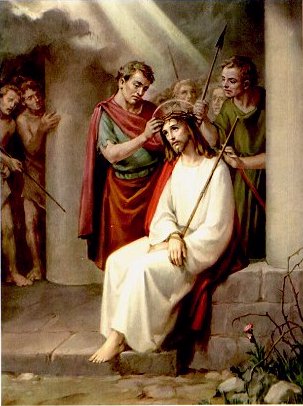
The Crowing of Thorns
In other words, one can group the Mysteries into themes in a way (or even ways) other than the Joyful, Luminous, Sorrowful and Glorious.

The Standard Narrative

The way the Mysteries are usually put together is strictly chronologically, with the overall pattern of:
  • Times of joy in Christ’s life, before His public ministry
  • Times of especial light (or revelation) about Who He is
  • The sorrows of His Passion and Death
  • The glories that followed

I have always thought of them as basically a chronological overview of Christ’s life, which we reflect upon with His Mother, so that, meditating upon these events which are full of significance, we might “imitate what they contain and obtain what they promise”.

I never thought, until recently, to compare corresponding mysteries with each other, to see how else they might fit together, and what light they might thereby shed on each other. (Such an idea may, of course, be extended to include reflections that compare the Mysteries of the Rosary with other events in Sacred Scripture, whether from the Old or the New Testament.)

I am going to argue, by looking at each set of corresponding Mysteries in turn, that what we have going on here is a bit of recapitulation and prolepsis. Ok, what is that? I'll do a bit of quoting from my summary of Dr Robert Tilley's paper Tradition, Temporality and Transcendence: A Biblical Ontology of Time and Space, presented at the Tradition Conference:
The Bible’s recapitulative logic consists in the notion that time and space interact such that the “past is really and truly repeated in the present” and this is perfected and fulfilled in the human person, specifically in the mediating covenant representatives. Prolepsis means that the “present can, in some manner, truly participate in the future, in that what is in the future is the locus of their fulfilment and perfection."
In other words, the Biblical conceptions of time and space are such that it presents history simultaneously repeating itself (after something has happened), but also participating in the future (before it has happened), and this is perfected and fulfilled in the liturgy. This presentation of reality is evident throughout the Scriptures and salvation history, and I think in the Mysteries of the Rosary we have a microcosm of this broader reality going on, focused here specifically around Christ’s coming and His work of salvation. Hopefully these somewhat abstract statements will become clear(er) in future posts!


+AMDG

Novenas and Bacon


For some time I've been working my way through a 54 day Rosary Novena. Frankly, it's one of the toughest things I've ever done, but I always feel comforted in my poor attempts at concentration and perseverance by the following from Bad Catholic (specifically, the bit in bold):
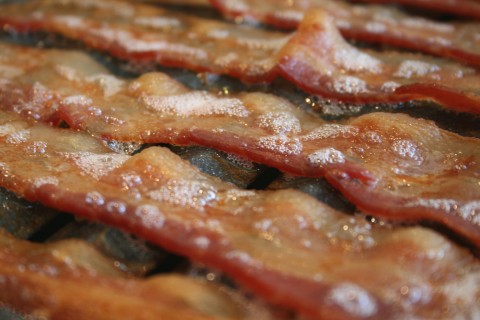
We’ve all been there, when our prayer curls up and dies like spiders on our lips, when the faith that surrounds us bores, when Mass is a chore, fasting a pain, and obedience to The Church frightfully difficult. There are times when I do get tired of it all, dammit. (I am usually made aware of this sad fact when praying my Rosary, and halfway through the third mystery I realize I’ve spent 35 Hail Marys thinking about bacon. And not even the Father-of-the-English-Renaissance-variety.))


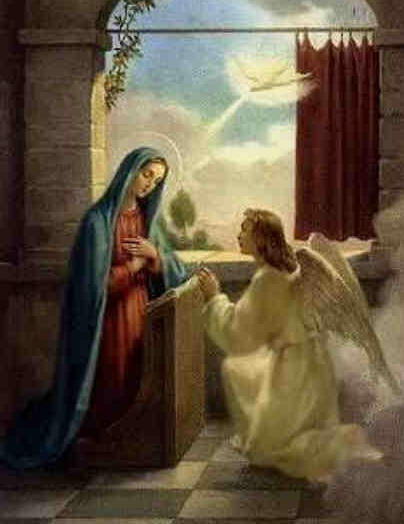
The First Joyful Mystery... The Annuncia-
DUDE. I can soooo relate. And thank goodness I'm not the only one!! Reminders that everyone struggles are always a massive help. Which ought perhaps to remind us not to hide our struggles so much, as an act of charity.

Anyway, it's taken about 45 days, but I had a bit of an epiphany moment regarding some thematic awesomeness within the Mysteries of the Rosary!! I'm going to leave you in suspense now... muahaha.

PS. For some bacon hilarity, see Jim Gaffifan.

BACON!!!!

Sunday, 4 August 2013

Unity between denominations? Part VIII: Toward Unity

Part VII: Wounds to Unity

Having pondered the question of unity for some time now, regarding what it is, and what it is not, we finally come to consider how unity may be worked towards, by the individual, the local Church, and the Universal Church.

Toward unity

820 "Christ bestowed unity on his Church from the beginning. This unity, we believe, subsists in the Catholic Church as something she can never lose, and we hope that it will continue to increase until the end of time."277 Christ always gives his Church the gift of unity, but the Church must always pray and work to maintain, reinforce, and perfect the unity that Christ wills for her. This is why Jesus himself prayed at the hour of his Passion, and does not cease praying to his Father, for the unity of his disciples: "That they may all be one. As you, Father, are in me and I am in you, may they also be one in us, . . . so that the world may know that you have sent me."278 The desire to recover the unity of all Christians is a gift of Christ and a call of the Holy Spirit.279

821 Certain things are required in order to respond adequately to this call:
- a permanent renewal of the Church in greater fidelity to her vocation; such renewal is the driving-force of the movement toward unity;280
- conversion of heart as the faithful "try to live holier lives according to the Gospel";281 for it is the unfaithfulness of the members to Christ's gift which causes divisions;
- prayer in common, because "change of heart and holiness of life, along with public and private prayer for the unity of Christians, should be regarded as the soul of the whole ecumenical movement, and merits the name 'spiritual ecumenism;"'282
- fraternal knowledge of each other;283
- ecumenical formation of the faithful and especially of priests;284
- dialogue among theologians and meetings among Christians of the different churches and communities;285
- collaboration among Christians in various areas of service to mankind.286 "Human service" is the idiomatic phrase.

822 Concern for achieving unity "involves the whole Church, faithful and clergy alike."287 But we must realize "that this holy objective - the reconciliation of all Christians in the unity of the one and only Church of Christ - transcends human powers and gifts." That is why we place all our hope "in the prayer of Christ for the Church, in the love of the Father for us, and in the power of the Holy Spirit."288


Part IX: What can I do?

Wednesday, 31 July 2013

Unity between denominations? Part VII: Wounds to Unity

Previously:

Part I: The Problem
Part II: What kind of unity are we called to?
Part III: The Witness of the Early Church in the New Testament


Part VI: The unity of the Church in Her own words

Continuing from the Catechism, what kinds of actions or attitudes are harmful to the unity of the Church? The Church here also makes clear that those born into communities separated from full communion to the Body of Christ are not personally to blame.

Wounds to unity

817 In fact, "in this one and only Church of God from its very beginnings there arose certain rifts, which the Apostle strongly censures as damnable. But in subsequent centuries much more serious dissensions appeared and large communities became separated from full communion with the Catholic Church - for which, often enough, men of both sides were to blame."269 The ruptures that wound the unity of Christ's Body - here we must distinguish heresy, apostasy, and schism - do not occur without human sin:
Where there are sins, there are also divisions, schisms, heresies, and disputes. Where there is virtue, however, there also are harmony and unity, from which arise the one heart and one soul of all believers.271
These wounds are defined elsewhere in the Catechism as follows, under sins against faith:

2089 Incredulity is the neglect of revealed truth or the willful refusal to assent to it.
"Heresy is the obstinate post-baptismal denial of some truth which must be believed with divine and catholic faith, or it is likewise an obstinate doubt concerning the same;
apostasy is the total repudiation of the Christian faith;
schism is the refusal of submission to the Roman Pontiff or of communion with the members of the Church subject to him."

818 "However, one cannot charge with the sin of the separation those who at present are born into these communities [that resulted from such separation] and in them are brought up in the faith of Christ, and the Catholic Church accepts them with respect and affection as brothers . . . . All who have been justified by faith in Baptism are incorporated into Christ; they therefore have a right to be called Christians, and with good reason are accepted as brothers in the Lord by the children of the Catholic Church."272 819 "Furthermore, many elements of sanctification and of truth"273 are found outside the visible confines of the Catholic Church: "the written Word of God; the life of grace; faith, hope, and charity, with the other interior gifts of the Holy Spirit, as well as visible elements."274 Christ's Spirit uses these Churches and ecclesial communities as means of salvation, whose power derives from the fullness of grace and truth that Christ has entrusted to the Catholic Church. All these blessings come from Christ and lead to him,275 and are in themselves calls to "Catholic unity."276


Part VIII: Towards Unity

Monday, 22 July 2013

Unity between Denominations? Part VI: The unity of the Church in Her own words

Previously:

Part I: The Problem
Part II: What kind of unity are we called to?
Part III:  The Witness of the Early Church in the New Testament
Part IV: The Witness of the Early Church in the Church Fathers
Part V: Visible vs. Invisible Unity

The next few parts will mostly be sections from our beloved Catechism.

First up: How is the Church Christ founded One?


813 The Church is one because of her source: "the highest exemplar and source of this mystery is the unity, in the Trinity of Persons, of one God, the Father and the Son in the Holy Spirit."

The Church is one because of her founder: for "the Word made flesh, the prince of peace, reconciled all men to God by the cross, . . . restoring the unity of all in one people and one body."

The Church is one because of her "soul": "It is the Holy Spirit, dwelling in those who believe and pervading and ruling over the entire Church, who brings about that wonderful communion of the faithful and joins them together so intimately in Christ that he is the principle of the Church's unity."

Unity is of the essence of the Church: What an astonishing mystery! There is one Father of the universe, one Logos of the universe, and also one Holy Spirit, everywhere one and the same; there is also one virgin become mother, and I should like to call her "Church."

814 From the beginning, this one Church has been marked by a great diversity which comes from both the variety of God's gifts and the diversity of those who receive them. Within the unity of the People of God, a multiplicity of peoples and cultures is gathered together. Among the Church's members, there are different gifts, offices, conditions, and ways of life. "Holding a rightful place in the communion of the Church there are also particular Churches that retain their own traditions."

The great richness of such diversity is not opposed to the Church's unity. Yet sin and the burden of its consequences constantly threaten the gift of unity. And so the Apostle has to exhort Christians to "maintain the unity of the Spirit in the bond of peace."

815 What are these bonds of unity? Above all, charity "binds everything together in perfect harmony." But the unity of the pilgrim Church is also assured by visible bonds of communion:

  • profession of one faith received from the Apostles;
  • common celebration of divine worship, especially of the sacraments;
  • apostolic succession through the sacrament of Holy Orders, maintaining the fraternal concord of God's family.

816 "The sole Church of Christ [is that] which our Savior, after his Resurrection, entrusted to Peter's pastoral care, commissioning him and the other apostles to extend and rule it. . . . This Church, constituted and organized as a society in the present world, subsists in (subsistit in) the Catholic Church, which is governed by the successor of Peter and by the bishops in communion with him."

The Second Vatican Council's Decree on Ecumenism explains: "For it is through Christ's Catholic Church alone, which is the universal help toward salvation, that the fullness of the means of salvation can be obtained. It was to the apostolic college alone, of which Peter is the head, that we believe that our Lord entrusted all the blessings of the New Covenant, in order to establish on earth the one Body of Christ into which all those should be fully incorporated who belong in any way to the People of God."

Delivery of the Keys (Perugino)

Part VII: Wounds to Unity

Sunday, 21 July 2013

Unity between Denominations? Part V: Visible vs. Invisible Unity

Previously:

Part I: The Problem
Part II: What kind of unity are we called to?
Part III:  The Witness of the Early Church in the New Testament

I have mentioned "visible" and "invisible" unity before, but without clearly defining what I mean by them and what their relationship is. Today I will attempt to rectify this.

What seems to be emerging from this series of posts is that Protestants are only able to have invisible unity, and it seems to me that they think visible unity is unimportant. Or at least, because visible unity is impossible in their paradigm, they are forced to this conclusion, otherwise they would be in the uncomfortable position of having to examine whether the whole paradigm is the problem.


The above title is actually a misnomer. There is no conflict between visible and invisible unity, in fact, they are two sides of the same reality, namely that the Church is One.

Let us consider the Church as the Body of Christ. What is a body? Well, a body without a soul is a just a corpse, and the Church is certainly not that, She is well and truly alive. She is Christ's resurrected body. In fact, She is the Incarnation continued in space and time. Thus St Joan of Arc could say, "About Jesus Christ and the Church, I simply know they're just one thing, and we shouldn't complicate the matter.” 

Thus, Church has a soul as well, in the Person of the Holy Spirit.


Hence the Church is a comprehensive unity of body and soul, of visible and invisible. If the invisible were not there, the visible would disintegrate. In other words, without the Holy Spirit acting in and through the Church, all that She said and did would lose its power and meaning. And if the visible were not there, as the manifestation of the invisible, the invisible unity would  be unrecognisable to the world, which would defeat the point of being one, which according to Christ is that people may know that we follow Christ by our oneness. And this oneness ought to be the same kind of oneness that exists between the Father and the Son.


And again, because it is precisely through the visible words and actions, and persons of the Church, that the Holy Spirit works to bring about this invisible communion, without the visible the invisible could not be sustained. They are inextricably intertwined.


There are many parallel paradoxes:
  • Scripture has both truly human and truly divine authors
  • Scripture is both a visible, limited thing and yet reveals to us the invisible, infinite God
  • Christ is both fully God and fully Man
  • The Church is both human and divine (fitting since She is intimately bound up with Her Spouse and Head)
  • a sacrament is a tangible sign of an invisible reality
These are all incarnational and sacramental, in keeping with the Catholic view of the tangible universe we live in being a "theatre of grace," the mysterious way in which the Creator interacts with His creation.