Monday, 12 August 2013

The Error of Compartmentalisation

The excellent Jason has kindly included myself in a list of his friends with good blogs. Over on his blog, with the awesome Phantom-of-the-Opera-esque name (at least that's what I think of) The Masked Thomist, Jason regularly displays his talent for concisely distilling his own thoughts, or those of others, deftly rebutting where appropriate. He also courageously shares various personal struggles, which I find quite inspiring, as well as helpful, providing a perspective not much voiced in the Catholic world.


Also on this list was the very new (only one post so far!) Platitudes in the Making. This first post was on the problem of compartmentalisation, with specific reference to mathematics and music. As someone with a degree in Advanced Mathematics, naturally this caught my attention. It's a very interesting read: did you know, for example that
Beethoven loved to take geometric figures and twist them, raise or lower them, taking certain points on the figures as musical notes, and write entire motifs that way.
What a cool way to compose!!

This compartmentalisation has troubled me for some time in other areas though, especially in the area of university education. It seems to me that the widespread specialisation of most degrees is not the best of ideas. Admittedly, part of the reason why I did Maths was because I hated essays, thought I was no good at them, nor could I ever be, because I just wasn't one of those "English-y types". If I'd been forced to non-Maths or Science subjects, I'd have been pretty ticked off, back in the day.

But now I think that learning to think in a variety of different ways, and learning skills different to the ones that you excel at, is ridiculously important.

When universities began, this was well understood. One didn't simply pick a specific area to be educated in, and specialise right from the get-go. You had to study rhetoric, grammar, logic, arithmetic, music, geometry and astronomy, before you could study philosophy, and before you reached the queen of all studies, theology. They understood that you had to be well-grounded in how the world is, how reality functions as a beautiful whole, in order to not be a slovely theologian.

These days, obviously not everyone is going to be a theologian. But I think there is nevertheless great merit in encouraging students to broaden their intellectual horizons.

Some ways this is done in Sydney:

UNSW gets their students to do a number of General Education (Gen Ed) subjects, which, as I understand it, are just subjects not in your field. This is a good start, but from what I hear most people don't take these seriously, don't really understand why they're important, and try to find "bludge" subjects: in other words, how little work they can get away with.

My own Notre Dame has the Logos Program, which basically involves getting a general introduction to the basics of philosophy, theology and ethics. This is definitely awesome in theory, but I'm not sure how much students get out of it (as I think many probably resent having "Catholic stuff shoved down our throats"), and also it's only three subjects worth.

Campion College is the winner on this front, as it offers the Liberal Arts degree, and that's all it does. Basically, you sit at the feet of history's greatest thinkers, and learn to think and express yourself well, in the areas of history, literature, philosophy, science and theology. By doing so Campion hopes to produce the leaders of the next generation, who are able to think well no matter what profession they choose to enter. Here, crucially, one's specialisation is delayed slightly, which I don't think is any bad thing. Many I have talked to, however, think it's a bit of a waste of time.

This pretty much because education is not generally seen as a good in itself, but merely as a means to getting a degree in something, so you can work. The idea of educating the whole person, aiding them in their pursuit of wisdom, so that they can live a virtuous life in accordance with what we were created for, and thus find true fulfilment, is non-existent in most universities. At Sydney Uni, I pretty much felt like one nobody among many, part of a production-line of graduates, helping the uni make money. This is the sorry state of our unis, which is not going to do society any favours, because university graduates go on to get positions of power and influence, and if they're not well-formed individuals, they're not likely to make well-informed decisions. And I think this is already being seen.

So, to conclude: if you have the chance to not narrow your straight after school, putting yourself into the "teaching" box, or the "politics" box, or the "science" box, or the "IT" box, go for it. Stretch those intellectual muscles! The world needs people who can both think logically and clearly, and express that well, whether in writing or verbally, and who know something of the rich inheritance of knowledge our forebears have bequeathed to us, so that they can contribute something valuable of their own.

+AMDG
 

Sunday, 11 August 2013

Rearranging the Rosary: The Third Mysteries (Kingdom of God)

Previously:
Rearranging the Rosary: An Introduction
The First Mysteries
The Second Mysteries

Finding a clear theme for the Second Mysteries is not so easy, and perhaps you found the result a bit dubious. Today, however, is much clearer, I think.

The Third Joyful Mystery: The Birth of Our Lord

  • Christ the King is born! He is recognised as such by the three wise men, who bring Him appropriate gifts.

The Third Luminous Mystery: The Proclamation of the Kingdom of Heaven

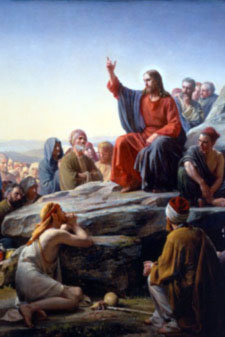
    Sermon on the Mount
  • At the Sermon on the Mount, Christ proclaims that the Kingdom of Heaven is at hand (because He is here and the redemption that He is going to bring about draws near)

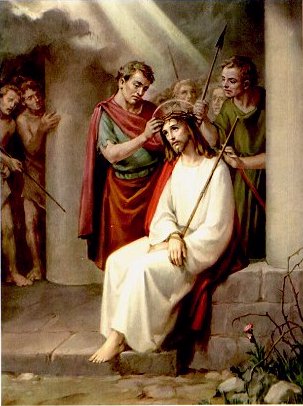
The Third Sorrowful Mystery: The Crowning with Thorns

  • Jesus is mocked by the soldiers for claiming to be King, by dressing Him in purple and setting a crown of thorns on His head. They taunt Him, and spit on Him. Little did they know that they were deriding He who truly is King of the Universe. (Yikes)

The Third Glorious Mystery: The Descent of the Holy Spirit on the Apostles

  • The pouring out of the Holy Spirit marked the birth of the Church, which is the Kingdom of God. What was accomplished on Calvary and in the Resurrection, was manifested anew in the Church, to be the means for the perpetuation of these salvific realities for all time. 

Thus, at some point we begin our lives as disciples of Christ, which involves both becoming a part of and working towards the complete fulfilment of the Kingdom of God.

Next up: The Fourth Mysteries

+AMDG

Saturday, 10 August 2013

Rearranging the Rosary: The Second Mysteries (Discipleship)

To make sense of this post, I suggest you check out the following:
Rearranging the Rosary: An Introduction
The First Mysteries

Today, I'll take an oh-so brief look at the Second Mysteries.

The Second Joyful Mystery: The Visitation
  • Right after learning that she is to be the Mother of God, Mary hurries over to assist her cousin Elizabeth, whom she has just learnt is also expecting, in her old age. This kind of service, that completely forgets the self, is what we are called to as disciples
  • John the Baptist, not even born yet, leaps for joy as he recognises that he is in the presence of the Lamb of God. Does being in God's presence lead to awe, amazement, and joy?
The Second Luminous Mystery: The Wedding at Cana 
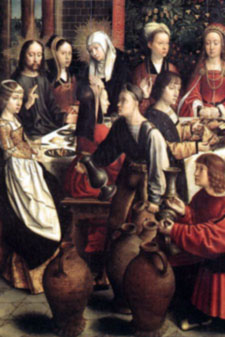
The Wedding at Cana

  • Our Lady's instructions to the servants: "Do whatever He tells you," provide the model for discipleship
  • This was the first sign that Jesus performed, and John tells us that the disciples "believed in Him"; (Jn. 2:11) belief in Christ is the crux of being a disciple.
The Second Sorrowful Mystery: The Scourging of Our Lord at the Pillar
  • We can unite the sufferings that we encounter, as disciples of Christ, with the immense suffering that the One whom we follow went through for us 
The Second Glorious Mystery: The Ascension of Our Lord into Heaven
  • Our Lord's final instruction to His Apostles before He left them, was to "Go, make disciples of all nations."
So, our Christian life has some kind of beginning, and this is the beginning of being a disciple of Christ, which involves a life of service, suffering, obedience, and a joy that should overflow with such abundance that we are led to share Christ with others.  

Next up: The Third Mysteries

+AMDG

Rearranging the Rosary: The First Mysteries (In the Beginning)

Yesterday I proposed that the Rosary could be looked at in a way other than the standard chronological narrative.

What am I talking about? Let’s look at the First Mysteries. (One could probably get much more out of this if one spent time looking at the relevant passages in depth, but I will leave that for another day, perhaps.)

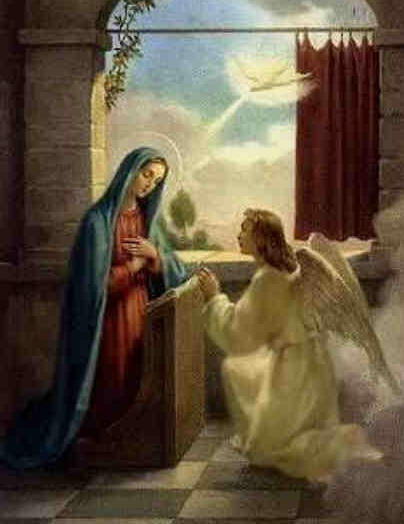
The First Joyful Mystery: The Annunciation

  • the moment when God the Son entered time and space to take on our human nature, and thus the beginning of His earthly life (and therefore also His mission) 
  • Trinitarian intimations
  • Our Lady's free and total "yes" to God's will
  • Mary becomes the Mother of God
The First Luminous Mystery: The Baptism of Our Lord

  • This is the beginning of His public ministry
  • Trinitarian intimations
  • baptism is elevated to a Sacrament, through which the Father says to us too "This is My beloved son/ daughter."
The First Sorrowful Mystery: The Agony of Our Lord in the Garden

  • The beginning of His Passion
  • Submission to the Father’s will
  • Humanity is on display
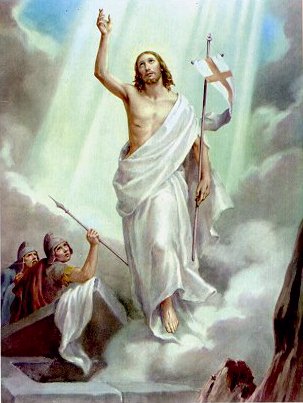
The Resurrection
The First Glorious Mystery: The Resurrection of Our Lord from the dead

  • The beginning of His glorified humanity

Ok so I got a bit lazy, but I'm sure more things will occur to me as I go. The obvious common thread here is that of a beginning. This might not sound all that impressive right now, but when connected with the themes of other Mysteries it will hopefully make more sense. Or maybe you're thinking, well duh, it's the first mystery, of course it's some kind of beginning. Oodelally! (the world should work harder towards making this word catch on.) Now we're both enlightened.

Next time: The Second Mysteries

+AMDG

Thursday, 8 August 2013

Rearranging the Rosary: An Introduction

Yesterday I mentioned that I’d had somewhat of an epiphany regarding the Mysteries of the Rosary. Today, all shall be revealed!! So what did I notice, exactly?

Namely, that if one takes all the third Mysteries, for example, from each of the groups (i.e. The Nativity, The Proclamation of the Kingdom, The Crowning of Thorns, and Pentecost) one can trace the outlines of some pretty interesting thematic contours.

The Crowing of Thorns
In other words, one can group the Mysteries into themes in a way (or even ways) other than the Joyful, Luminous, Sorrowful and Glorious.

The Standard Narrative

The way the Mysteries are usually put together is strictly chronologically, with the overall pattern of:
  • Times of joy in Christ’s life, before His public ministry
  • Times of especial light (or revelation) about Who He is
  • The sorrows of His Passion and Death
  • The glories that followed

I have always thought of them as basically a chronological overview of Christ’s life, which we reflect upon with His Mother, so that, meditating upon these events which are full of significance, we might “imitate what they contain and obtain what they promise”.

I never thought, until recently, to compare corresponding mysteries with each other, to see how else they might fit together, and what light they might thereby shed on each other. (Such an idea may, of course, be extended to include reflections that compare the Mysteries of the Rosary with other events in Sacred Scripture, whether from the Old or the New Testament.)

I am going to argue, by looking at each set of corresponding Mysteries in turn, that what we have going on here is a bit of recapitulation and prolepsis. Ok, what is that? I'll do a bit of quoting from my summary of Dr Robert Tilley's paper Tradition, Temporality and Transcendence: A Biblical Ontology of Time and Space, presented at the Tradition Conference:
The Bible’s recapitulative logic consists in the notion that time and space interact such that the “past is really and truly repeated in the present” and this is perfected and fulfilled in the human person, specifically in the mediating covenant representatives. Prolepsis means that the “present can, in some manner, truly participate in the future, in that what is in the future is the locus of their fulfilment and perfection."
In other words, the Biblical conceptions of time and space are such that it presents history simultaneously repeating itself (after something has happened), but also participating in the future (before it has happened), and this is perfected and fulfilled in the liturgy. This presentation of reality is evident throughout the Scriptures and salvation history, and I think in the Mysteries of the Rosary we have a microcosm of this broader reality going on, focused here specifically around Christ’s coming and His work of salvation. Hopefully these somewhat abstract statements will become clear(er) in future posts!


+AMDG

Novenas and Bacon


For some time I've been working my way through a 54 day Rosary Novena. Frankly, it's one of the toughest things I've ever done, but I always feel comforted in my poor attempts at concentration and perseverance by the following from Bad Catholic (specifically, the bit in bold):
We’ve all been there, when our prayer curls up and dies like spiders on our lips, when the faith that surrounds us bores, when Mass is a chore, fasting a pain, and obedience to The Church frightfully difficult. There are times when I do get tired of it all, dammit. (I am usually made aware of this sad fact when praying my Rosary, and halfway through the third mystery I realize I’ve spent 35 Hail Marys thinking about bacon. And not even the Father-of-the-English-Renaissance-variety.))


The First Joyful Mystery... The Annuncia-
DUDE. I can soooo relate. And thank goodness I'm not the only one!! Reminders that everyone struggles are always a massive help. Which ought perhaps to remind us not to hide our struggles so much, as an act of charity.

Anyway, it's taken about 45 days, but I had a bit of an epiphany moment regarding some thematic awesomeness within the Mysteries of the Rosary!! I'm going to leave you in suspense now... muahaha.

PS. For some bacon hilarity, see Jim Gaffifan.

BACON!!!!

Sunday, 4 August 2013

Unity between denominations? Part VIII: Toward Unity

Part VII: Wounds to Unity

Having pondered the question of unity for some time now, regarding what it is, and what it is not, we finally come to consider how unity may be worked towards, by the individual, the local Church, and the Universal Church.

Toward unity

820 "Christ bestowed unity on his Church from the beginning. This unity, we believe, subsists in the Catholic Church as something she can never lose, and we hope that it will continue to increase until the end of time."277 Christ always gives his Church the gift of unity, but the Church must always pray and work to maintain, reinforce, and perfect the unity that Christ wills for her. This is why Jesus himself prayed at the hour of his Passion, and does not cease praying to his Father, for the unity of his disciples: "That they may all be one. As you, Father, are in me and I am in you, may they also be one in us, . . . so that the world may know that you have sent me."278 The desire to recover the unity of all Christians is a gift of Christ and a call of the Holy Spirit.279

821 Certain things are required in order to respond adequately to this call:
- a permanent renewal of the Church in greater fidelity to her vocation; such renewal is the driving-force of the movement toward unity;280
- conversion of heart as the faithful "try to live holier lives according to the Gospel";281 for it is the unfaithfulness of the members to Christ's gift which causes divisions;
- prayer in common, because "change of heart and holiness of life, along with public and private prayer for the unity of Christians, should be regarded as the soul of the whole ecumenical movement, and merits the name 'spiritual ecumenism;"'282
- fraternal knowledge of each other;283
- ecumenical formation of the faithful and especially of priests;284
- dialogue among theologians and meetings among Christians of the different churches and communities;285
- collaboration among Christians in various areas of service to mankind.286 "Human service" is the idiomatic phrase.

822 Concern for achieving unity "involves the whole Church, faithful and clergy alike."287 But we must realize "that this holy objective - the reconciliation of all Christians in the unity of the one and only Church of Christ - transcends human powers and gifts." That is why we place all our hope "in the prayer of Christ for the Church, in the love of the Father for us, and in the power of the Holy Spirit."288


Part IX: What can I do?